
Read it in the WGF Library: The Paul Henning Collection
You probably know all about the WGF’s treasure trove of tens of thousands of scripts from all decades of screenwriting, but you might not know we have an Archive. An archive is made up of “collections,” which consist of documents, media, photos, correspondence and more from a particular person or organization. At the WGF, the bulk of our collections come from prominent WGA members. We also have records relating to the 1933 formation and first few decades of the Screen Writers’ Guild. If you are a casual user of the library, you might not realize that the WGF’s archival collections are available to you for research when you make a library appointment.
I’m Hilary Swett, WGF Archivist. I’m going to give you a peek at what I’m working on right now and perhaps inspire you to take a deeper look at a classic TV show, The Beverly Hillbillies, which stayed on the public’s radar over many decades thanks to countless reruns and an earworm of a theme song.
“Have you ever wanted to take a character or group of characters from history and plunk them down in the middle of our modern world and watch their amazed reaction? […] Outside of a dream sequence or wildly unbelievable farce it is completely impossible. Well, not completely…”
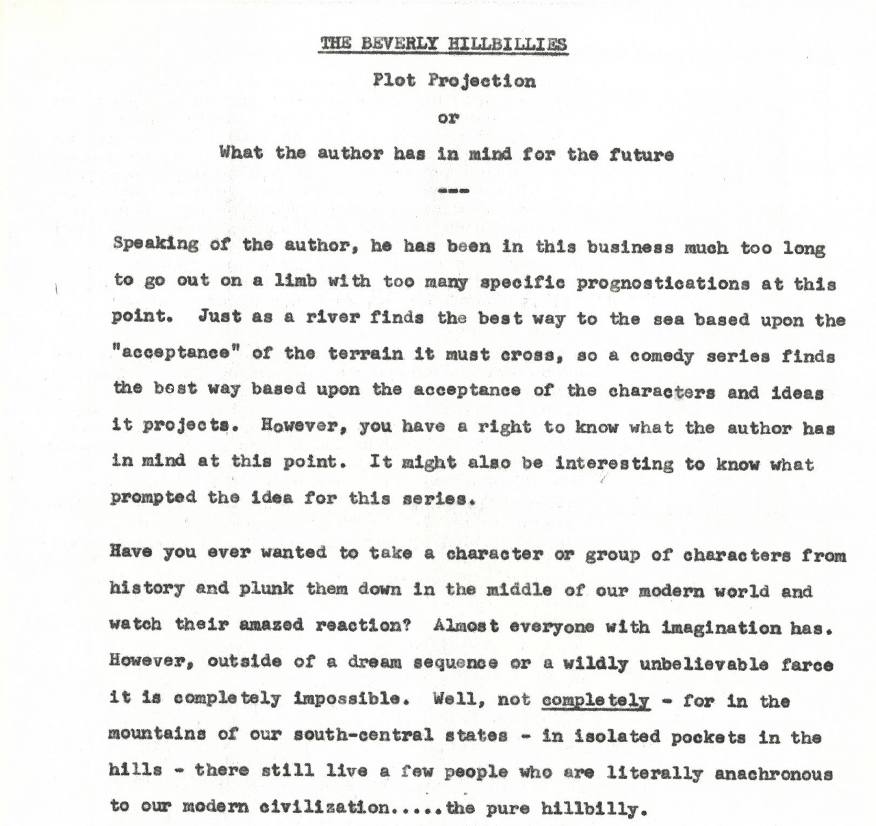
Opening of the '“plot projection” written by Paul Henning to describe the premise of The Beverly Hillbillies.
This is an excerpt from the second paragraph of a short pitch written by creator Paul Henning about his vision for the show. Henning grew up in Independence, Missouri and the idea for The Beverly Hillbillies was inspired by times he spent camping in the Ozark Mountains. What would happen if you took a backwoods family and dropped them into urban life? This fish-out-of-water angle was not new but the characters and their circumstances were. The show derived humor from the hillbillies’ lack of education and culture but also showed them as kind, loyal, and honest. And they brought these values to city life rather than the city changing them. We can all relate to characters who find themselves in unfamiliar situations and we like them rather than pity them. This basic recipe proved to be just what audiences wanted.
Premiering in 1962, the show ran for nine seasons, finishing seasons 1 and 2 as the most-watched show on TV and remaining in the top 20 for seasons 3 through 8. Henning wrote or co-wrote well over 200 of the series' 274 episodes, including every episode of seasons one, two, three, eight, and nine. Other writers who worked on the show include Mark Tuttle, Dick Wesson, Buddy Atkinson, Debra Haber and Phil Shuker.
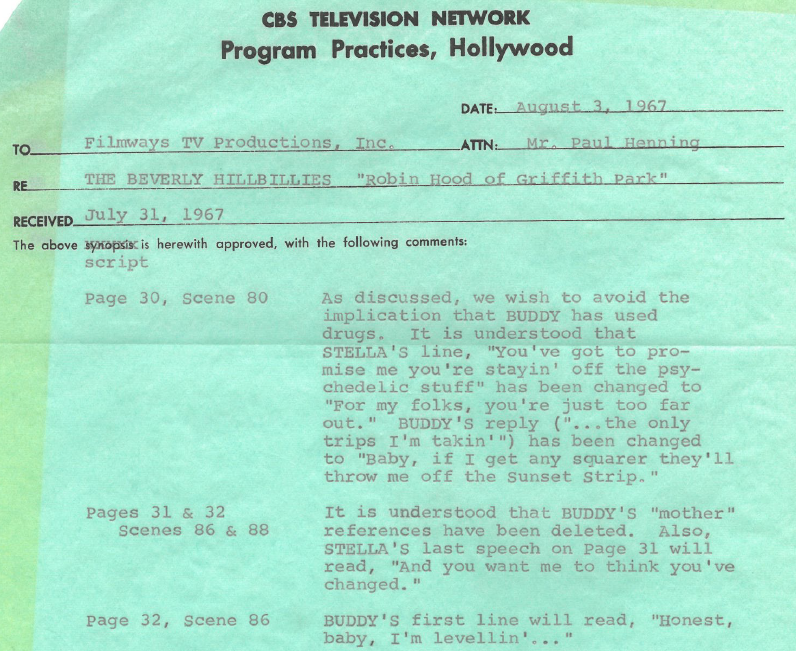
Memo from CBS Program Practices asking for the show to revise the mentions of drug use in the 6th season episode “Robin Hood of Griffith Park,” which aired September 27, 1967.
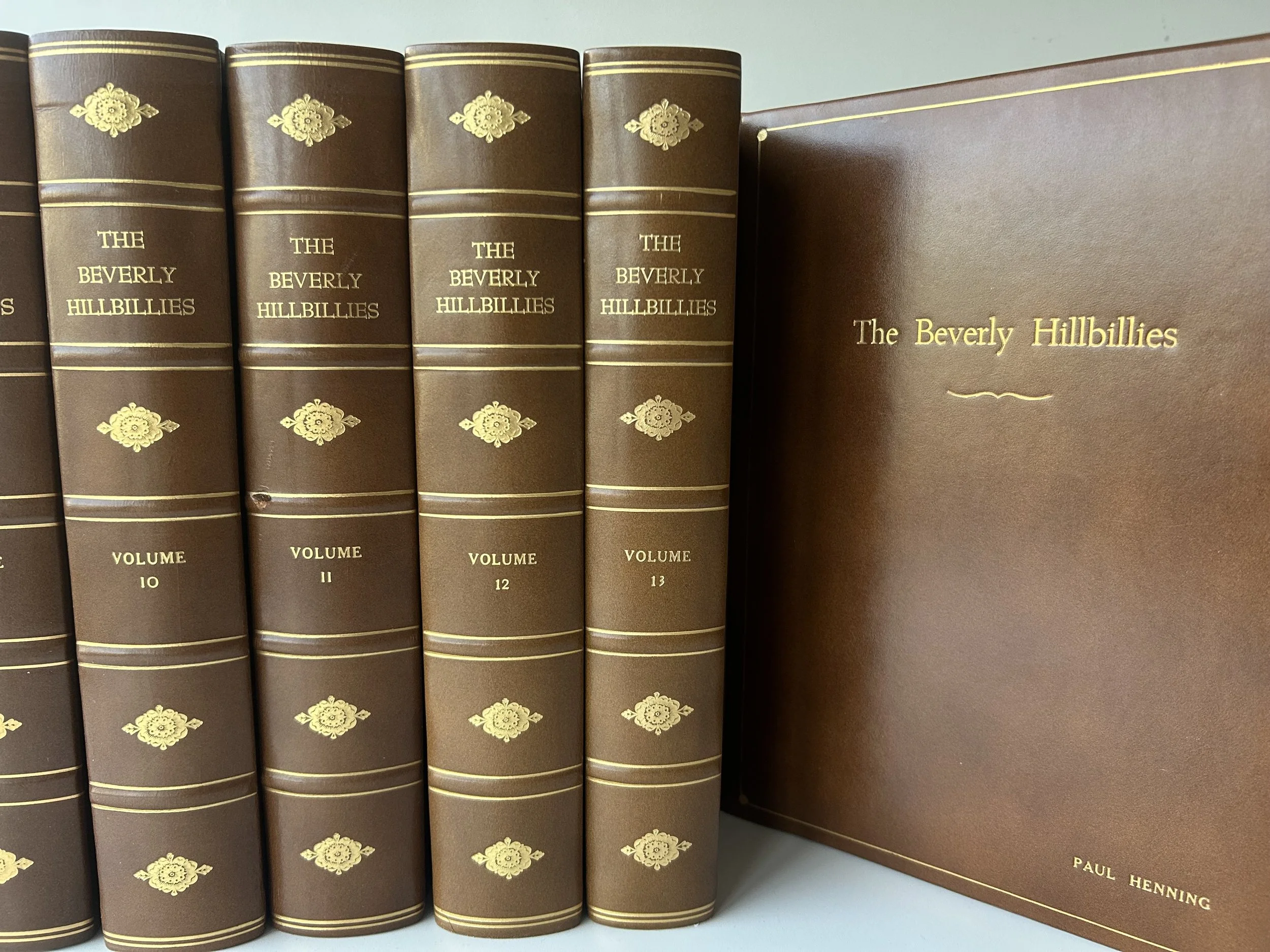
The Paul Henning Collection includes scripts for all episodes of The Beverly Hillbillies in 22 bound volumes.
We recently received a donation from Henning’s three children of all the scripts from the show. Each episode was in a file folder along with call sheets, shooting schedules, cast lists, memos from CBS Program Practices and more.
In addition to these folders, the collection includes:
The sheet music for the iconic opening theme song “The Ballad of Jed Clampett,” with music and lyrics by Paul Henning. The song made its first appearance in the second episode of the show.
Production and promotional paperwork from shooting a multiple-episode story arc in England for the opening of season 6.
A pilot script and storyboards for a proposed animated reboot of the series as a Saturday morning cartoon.
Aside from The Beverly Hillbillies, Henning wrote and/or produced other films, pilots, and TV shows which can also be found in his collection. Over his career, he earned three Emmy nominations, a WGA Award nomination, and he and co-writer Stanley Shapiro were nominated for Oscars for their 1961 romantic comedy screenplay Lover, Come Back. In 1996, Henning was awarded the WGA’s highest honor, the Paddy Chayefsky Laurel Award for Television Writing Achievement. We are so pleased to preserve Henning’s legacy and share his collection with patrons.
These papers, and archival collections in general, paint a broader picture of someone’s career and give insight into their creative process. Seeing notes, unending drafts and projects that never got produced illuminate what it truly means to be a working professional writer. When materials are donated to us, we re-house, organize and arrange them in acid-free folders and archival boxes to preserve them and make the deluge of items more discoverable and digestible by researchers. We then create narrative, descriptive summaries called finding aids for both our online catalog and the Online Archive of California.
In fact, the best way to discover WGF’s archival collections is by searching for titles or writers in our catalog or browsing through the list of our collection guides at the OAC.
Paul Henning’s collection, like many we have, is quite large with components stored off-site. If you want to consult this or other archival material for research, we recommend checking with us via e-mail before you schedule an appointment.
When you visit our library, you can learn more Henning and The Beverly Hillbillies in the book The First Beverly Hillbilly: The Untold Story of the Creator of Rural TV Comedy, written by his wife Ruth in 1994 and later published in 2017.
Libraries aren’t just for research and reading — they’re centers for community. Help us continue to preserve the work of film and TV writers and uplift the next generation by making a donation today.