
Read it in the WGF Library: The Caroline Thompson Collection
Most archives contain what we call “collections.” These collections consist of documents, media, photos, correspondence and more from a particular person or organization.
At the Writers Guild Foundation, the bulk of our collections come from prominent WGA members. We also have records relating to the 1933 formation and first few decades of the Screen Writers’ Guild.
As a casual user of the library, you might not realize that the WGF’s archival collections are available to you for research when you make a library appointment.
I’m Lauren O’Connor, WGF Librarian, and one of my favorite collections in our archive is The Caroline Thompson Collection. In this post, I’ll tell you a little bit about this collection and hopefully shine a light on how to access these unique materials on your next visit.
Caroline Thompson is the writer behind beloved films like Edward Scissorhands, The Secret Garden and The Nightmare Before Christmas. If you’re a writer and you crave insights into how endearing, classic characters are created, this collection will be an invaluable study for you.
Here’s what to know:
Collections typically come to us from writers themselves or their families/contacts when they’re cleaning out their home office or garage. Thompson donated her papers to us in 2019.
The collection is especially rich in outlines, notes, notecards and script drafts from Edward Scissorhands, which was Thompson’s first produced feature film credit. (Tim Burton told her about a drawing he’d done in high school of a character with scissors for hands and the idea grew from there).
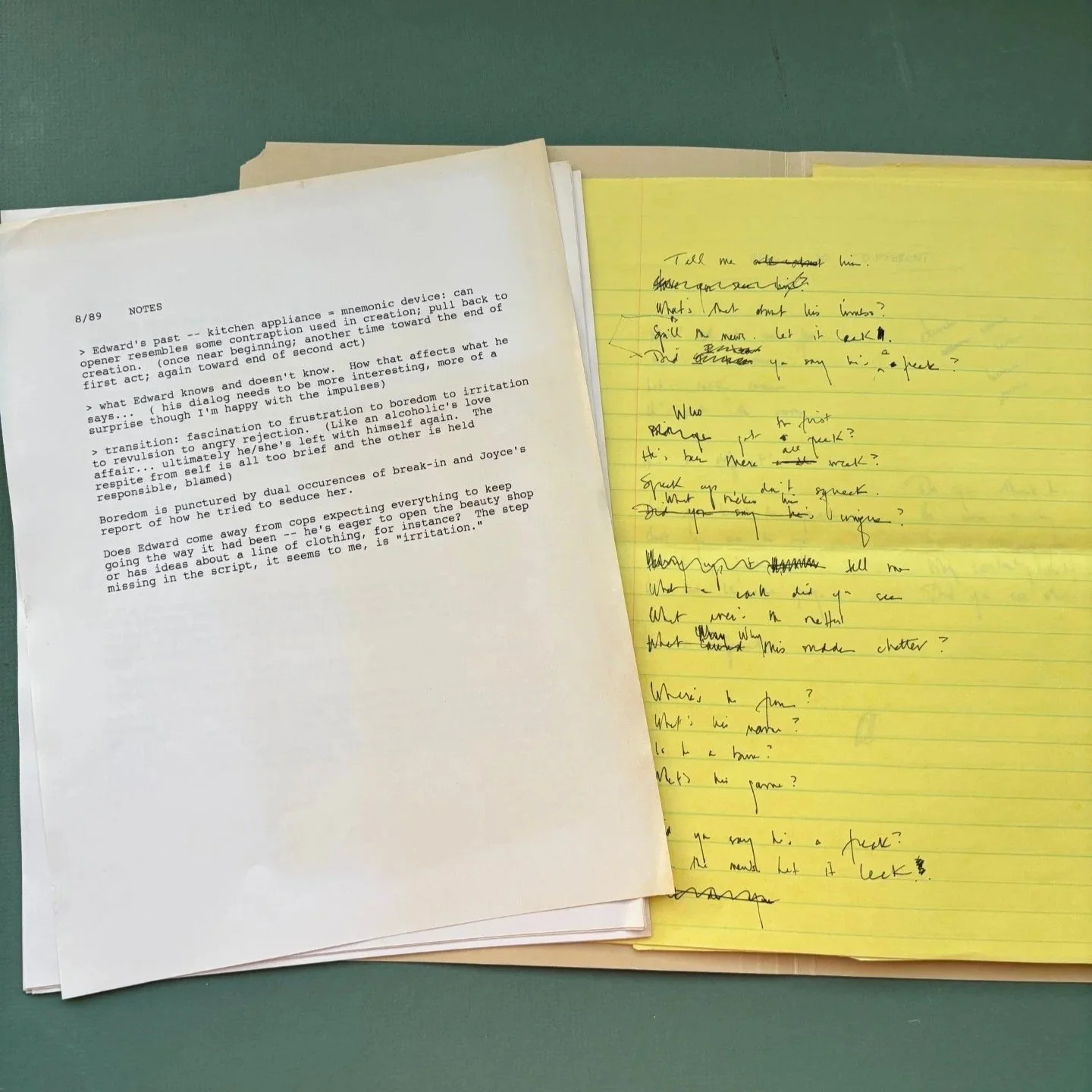
Notes from the development of Edward Scissorhands in the Caroline Thompson Collection
If you study early notecards in the collection, you’ll see that Edward Scissorhands was originally developed to be a musical. Two early treatments for the film still contain songs and lyrics. The documents show that conceptualizing a project as a musical can be helpful, especially if you’re stuck trying to figure out a character’s inner need. Even though the songs were scrapped, the characters in the script have an interiority that sings. Edward has scissors for hands, but he just wants to be “normal.”
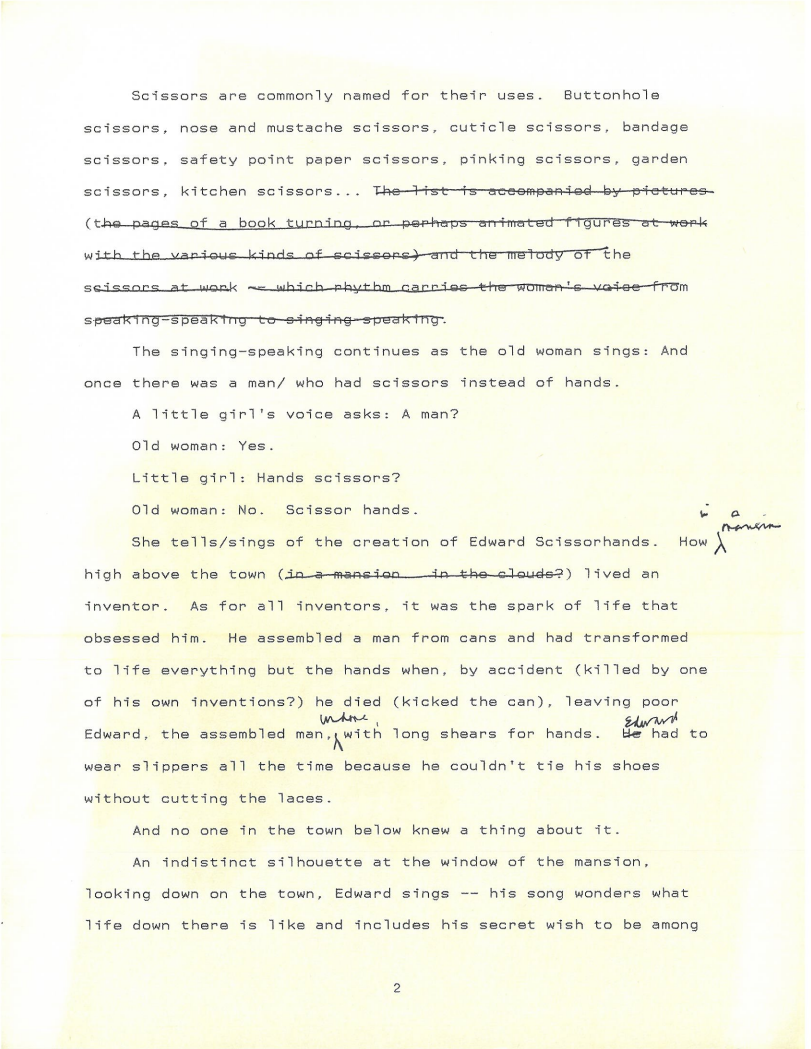
A page from a musical treatment for Edward Scissorhands in the Caroline Thompson collection.
The collection contains annotated Edward Scissorhands treatments as well as numerous drafts of the screenplay, including one draft with Tim Burton’s notes. His notes are more limited than you might think, revealing a huge amount of trust in Thompson’s writing. He mostly just specifies where she can trim certain scenes.

An annotated script draft of Edward Scissorhands with Tim Burton’s notes.
Also included in the collection is a draft of The Nightmare Before Christmas with Tim Burton’s notes. They are even more scant in this draft.

An image from a draft of The Nightmare Before Christmas with Tim Burton’s annotations.
Other collection highlights include a written outline for 2005’s Corpse Bride and a spiral idea notebook and notes from Disney executives about 1990’s Homeward Bound: The Incredible Journey, which Thompson co-wrote.

Image of notes from Disney on Homeward Bound: The Incredible Journey, part of the Caroline Thompson Collection
There are also scripts, ephemera and correspondence from Thompson’s other films including The Addams Family, Buddy, Black Beauty, City of Ember and The Secret Garden. Also included are development materials, outlines and script drafts for projects that never got produced, including a project with David Lynch called Snootworld.
Archival collections paint a broader picture of someone’s career – to see notes, unending drafts and projects that never got produced illuminates what it truly means to be a working professional writer, especially during a certain time period (here, the late 1980s through the late 1990s).
It’s inspiring to see that classic films don’t just pop out of someone’s head perfectly. Great films require craft and constant reiteration. The drafts, the outlines, the notes are all evidence that A PERSON WROTE IT.
When materials are donated to us, we re-house, organize and arrange them in acid-free folders and archival boxes to preserve them, but also to make the deluge of items more discoverable and digestible by researchers. We then create narrative, descriptive summaries called “finding aids” for both our online catalog and the Online Archive of California.
In fact, the best way to discover WGF’s archival collections is by searching film titles or writers in our catalog or browsing through the list of finding aids on the OAC.
Caroline Thompson’s collection is on the smaller side with most items stored on site at the WGF, but many collections are bulky and huge with components stored off-site. If you want to consult an archival collection for research, we recommend checking with us via e-mail before you schedule an appointment.
If you want to learn more about Caroline Thompson and her collection, check out this Writers on Writing event recorded Summer of 2020. We talk about specific items available for research in the collection.
Libraries aren’t just for research and reading — they’re centers for community. Help us continue to preserve the work of film and TV writers and uplift the next generation by making a donation today.