
WRITING YOUR SCREENPLAY: PAGE ONE
At the WGF Library, we operate under the belief that reading scripts is an essential part of becoming a better writer.
With each post in this series, we hone in on one particular aspect of writing, structuring, or formatting a feature screenplay. As we zero in on certain script elements and writing techniques, we will include short examples from some of our favorite feature scripts. (To clarify, this is a series about script drafts; not brainstorming or outlines or treatments, but putting words on the page.) While these posts primarily examine feature screenplays, much of the information should be helpful no matter what you write — TV, podcasts, novels, video games, plays, etc.
As always, if you have inquiries about scripts in the WGF Library (or about anything else writing-related), virtual reference assistance is available to you. E-mail library@wgfoundation.org. While we cannot send you PDFs of scripts, we can always advise and answer specific questions.
So, where do we start in a series about writing and formatting feature scripts?
Let’s start on page one.
The first page is the most significant page in a screenplay. As a writer, with that 8 1/2” by 11” space, you have the chance to express in a simple way what your movie is about, prove your capacity for writing cinematically AND (most importantly) compel your reader to turn to the next page. Classic screenwriting wisdom says you have 10 pages to hook your reader and prove you’re a good writer. This is generous. Most seasoned readers know: It really comes down to the first page.
If you find the prospect of the first page intimidating, it’s best to view it as an opportunity.
Let’s look at how eight different scripts utilize their first page.
ALL THE PRESIDENT’S MEN (1976)
Screenplay by William Goldman
Based on the book by Carl Bernstein & Bob Woodward
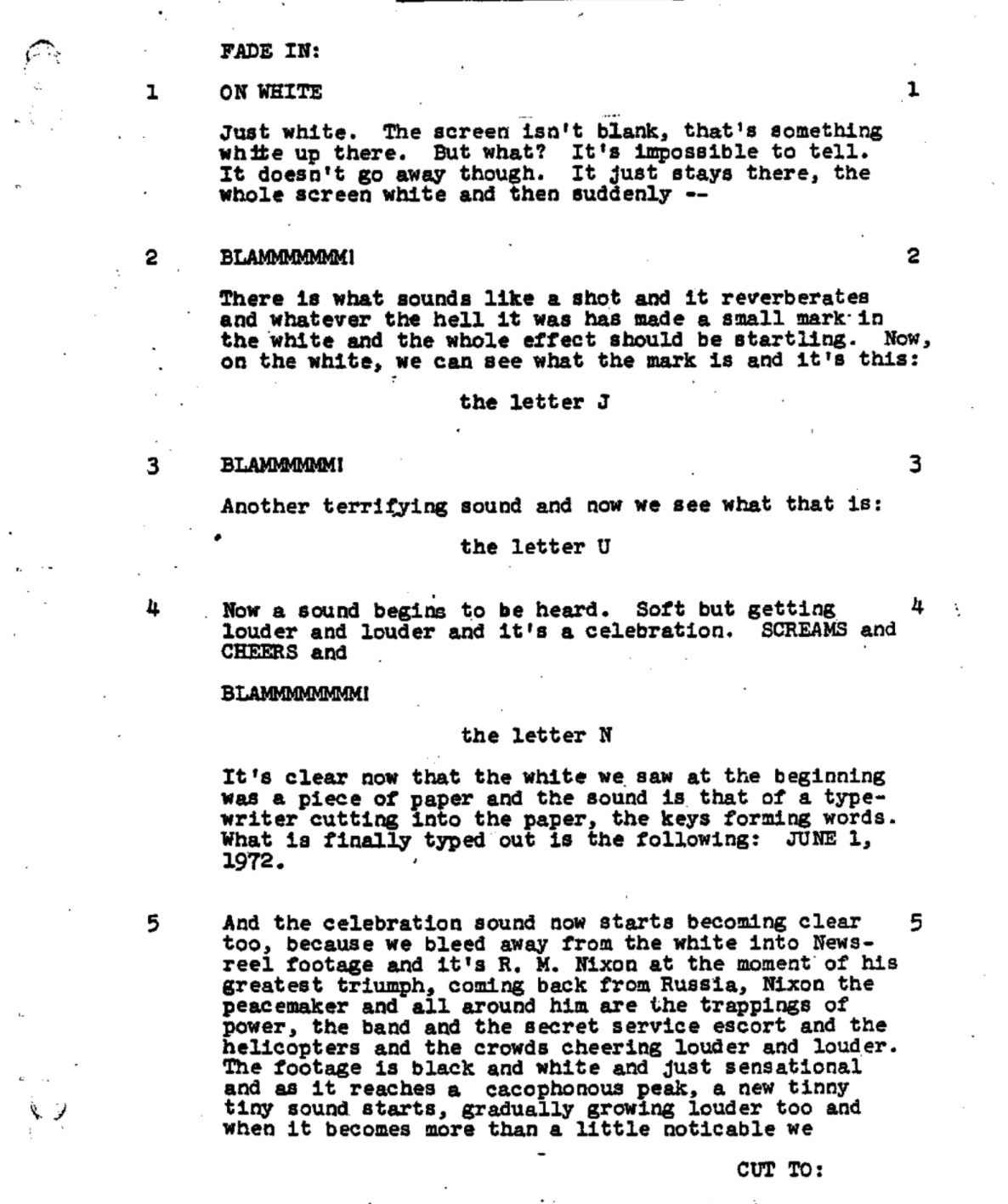
A few things to consider in the writing:
Goldman doesn’t use scene headings. This produces a kind of disorienting effect on the reader.
BLAAAAMM!! BLAAAAAAMM!! is written in comic book style onomatopoeia, which is always exciting to read.
Common storytelling advice is open where it’s “most interesting.” Here we think we’re witnessing GUNSHOTS, which gets our heart rates up immediately.
BUT it’s revealed that the BLAAAAAM gunshot sound is actually words being written with a typewriter… which is a powerful audiovisual metaphor… a statement about the disruptive power of words, which is, arguably, the theme of the movie.
BARBIE (2023)
Written by Greta Gerwig & Noah Baumbach
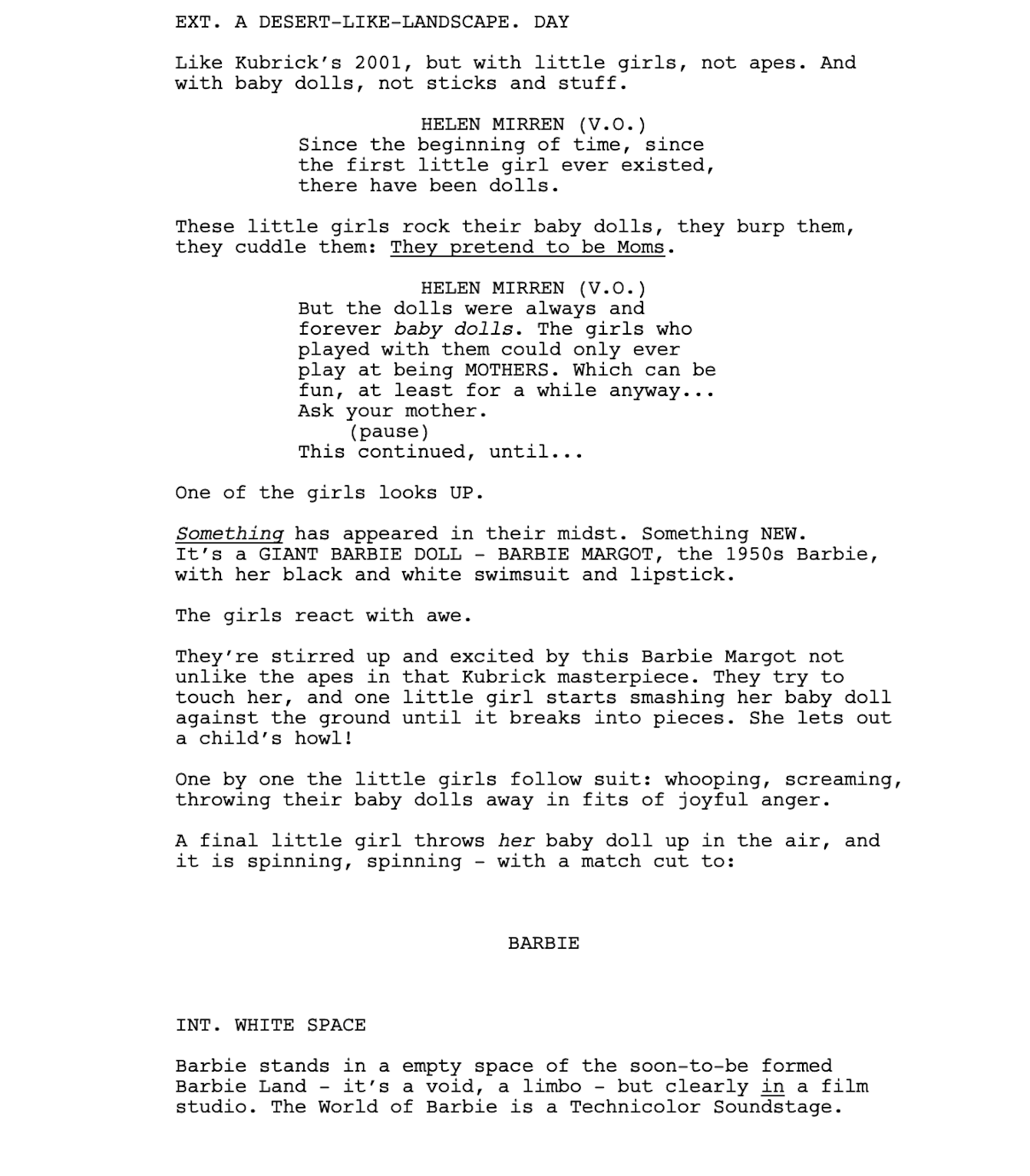
A few things to consider in the writing:
This first page gives us something familiar (the scene with the primitive men smashing bones from 2001: A Space Odyssey) in a fresh and exciting way.
Specifying Helen Mirren as the narrator confers importance on this scene where little girls smash their baby dolls.
The writing implies: this is going to be a smart movie that flips pop culture tropes on their head, which makes one want to turn to the page to see what happens next.
DO THE RIGHT THING (1989)
Written by Spike Lee
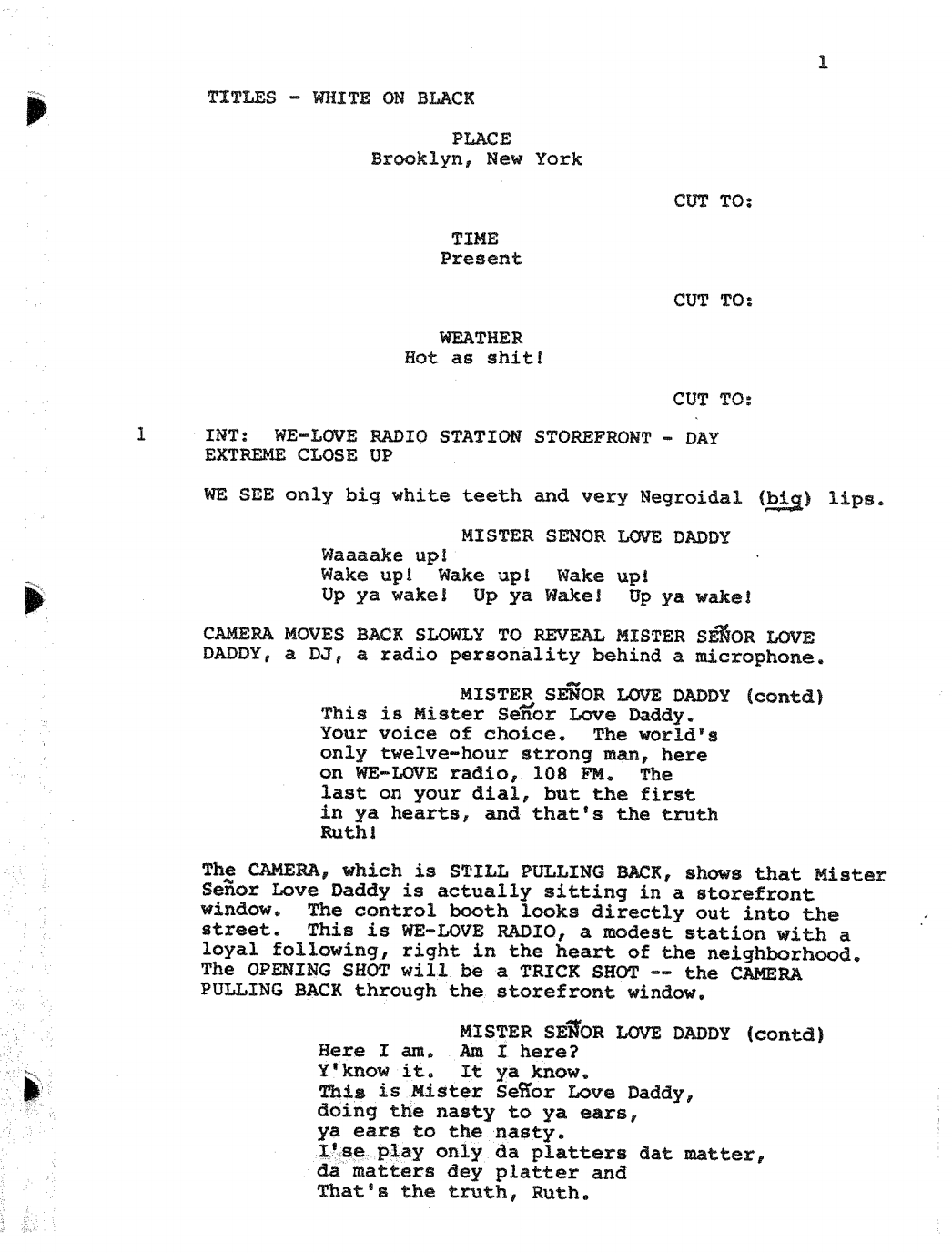
A few things to consider in the writing:
Right from the get-go, the script incorporates text on screen. This harkens back to the silent era and title cards, giving the words an urgency and magnitude. Lee uses the opportunity to give us a sense of his personal style — his writing style — at the beginning of the movie.
Do the Right Thing asks its viewers to WAKE-UP! That’s the backbone of the whole movie. It feels very deliberate to open with those words and to open on a close-up of a mouth speaking them.
It’s disorienting, just like the words on a typewriter in All the President’s Men, yet opening tight on lips and a mouth ensures that we are paying attention to the words spoken.
THE EDGE OF SEVENTEEN (2016)
Written by Kelly Fremon Craig

A few things to consider in the writing:
From the outset, we like this girl. The writing tells us she’s a misfit.
Nadine’s proclamation that she is going to take her own life grabs us by the throat on page one. This is an effective statement to open with because we — as readers or viewers — immediately start asking questions and anticipating. Is she really going to kill herself? Why does she want to kill herself? How is Mr. Bruner going to react?
Additionally, Nadine’s speech about the nature of her future suicide is so humorously detailed. The monologue shows us she’s smart and neurotic and needs to be noticed. More than anything, it makes us want to follow her (and Fremon Craig’s words) beyond just this first page.
EVE’S BAYOU (1997)
Written and Directed by Kasi Lemmons
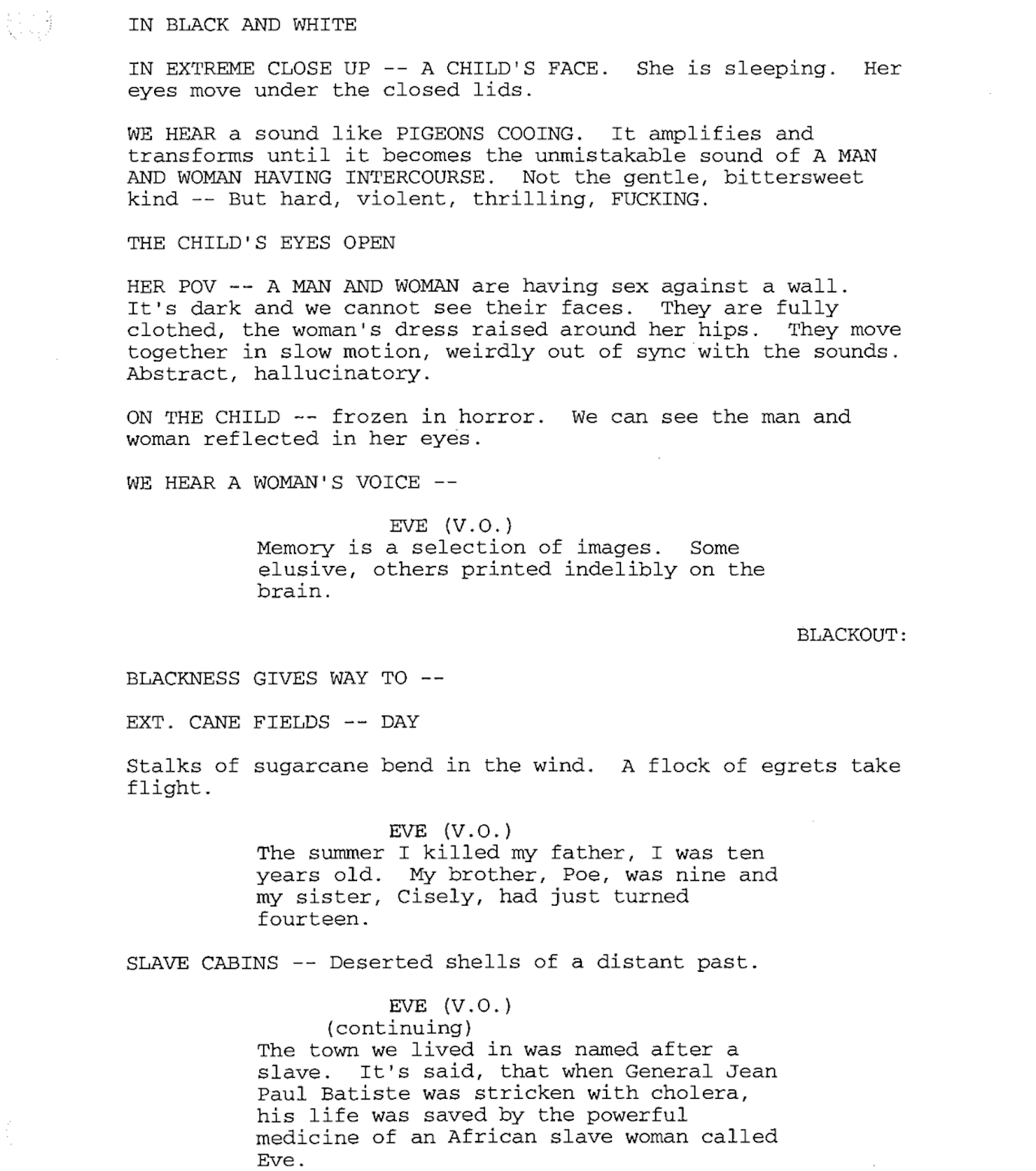
A few things to consider in the writing:
Right away on this first page, there is a distinct POINT OF VIEW. Lemmons puts us right into the perspective of Eve, a child. She’s witnessing something adult — two people having intercourse. It’s LOUD, LARGE, FRIGHTENING and the text is CAPITALIZED for effect.
This young girl also tells us this is the story of how she killed her father, which fires up our brains in anticipation of an obligatory scene. HOW is this girl going to kill her father? We have to turn the page to find out!
Finally, there’s a detail and richness to the world that this story takes place in that is apparent right here on the first page. We know we’re in good hands for this story that unfolds. We have to keep reading.
THE LONG KISS GOODNIGHT (1996)
Written by Shane Black
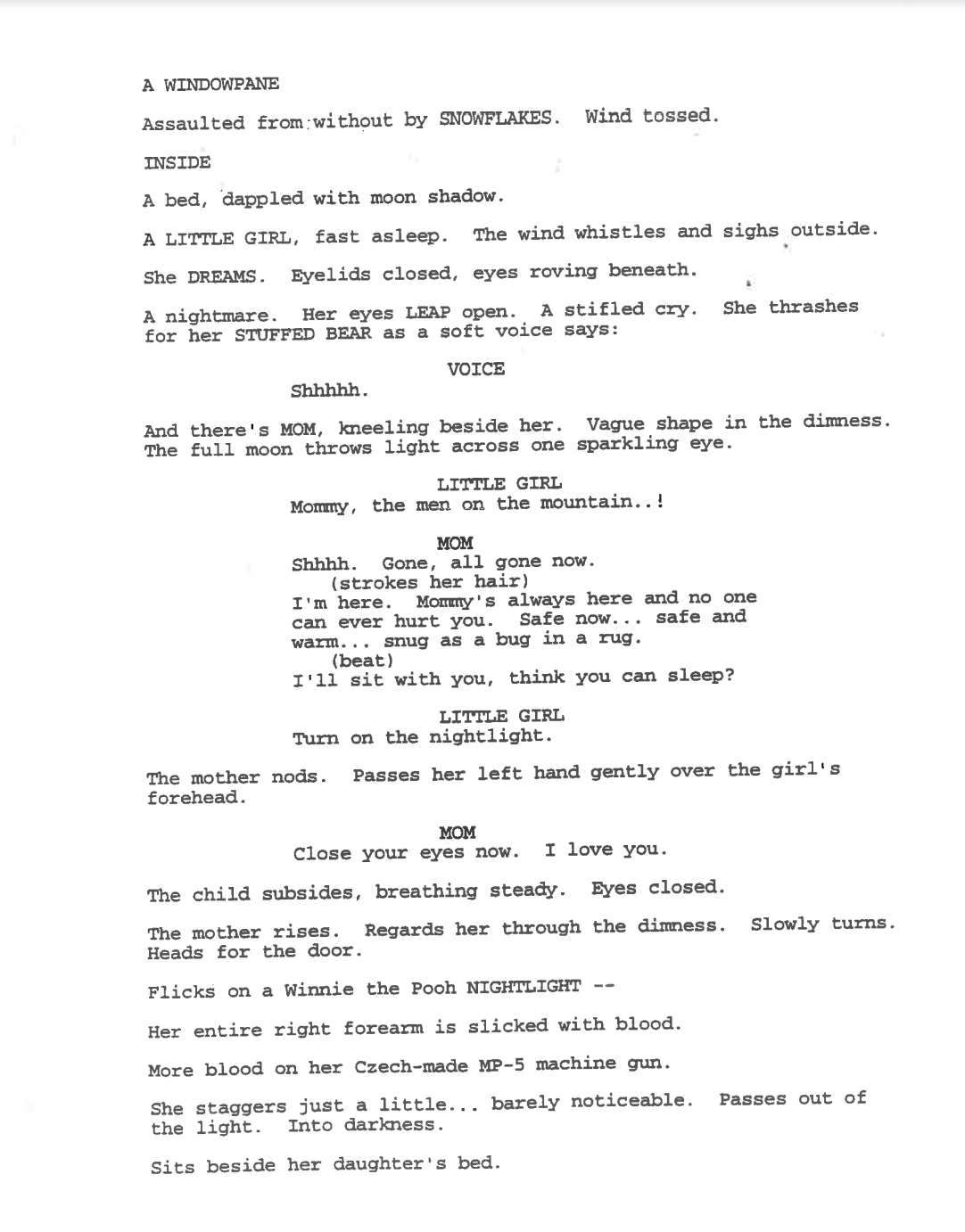
A few things to consider in the writing:
Notice there are only a few pieces of description on this page that go over one line. It’s almost as if every line is a new shot in the film. Also, the verbs used here really crackle, yet feel natural. All of it keeps the reader’s eye cascading effortlessly down the page.
The technique used in this instance is shocking contrast. The last thing the reader expects to see after a mother sweetly puts her child to sleep is that she’s holding a machine gun and that her arm is dripping with blood! Of course the reader is going to turn to the next page! This is also the same contrast that makes the mom (the protagonist) such a compelling character.
PARASITE (2019)
Screenplay by Bong Joon Ho and Han Jin Won
Story by Bong Joon Ho

A few things to consider in the writing:
In Parasite, the writers open with a family realizing they can no longer steal Wi-Fi. As readers, we get to watch how they react and attempt to work around this fact.
By the end of the first page, we know three things about this family: 1) They have no money, 2) They’re (lovingly) quick and abrasive with each other, and 3) Despite being poor, they’re resourceful and have humor.
Bong and Han don’t waste space with excessive description, simply giving us each character’s age and letting their actions and words speak for themselves.
The writing style is lean and — literally — mean and by the end of the page, WE’RE IN.
WILD (2014)
Screenplay by Nick Hornby; Based upon the book by Cheryl Strayed
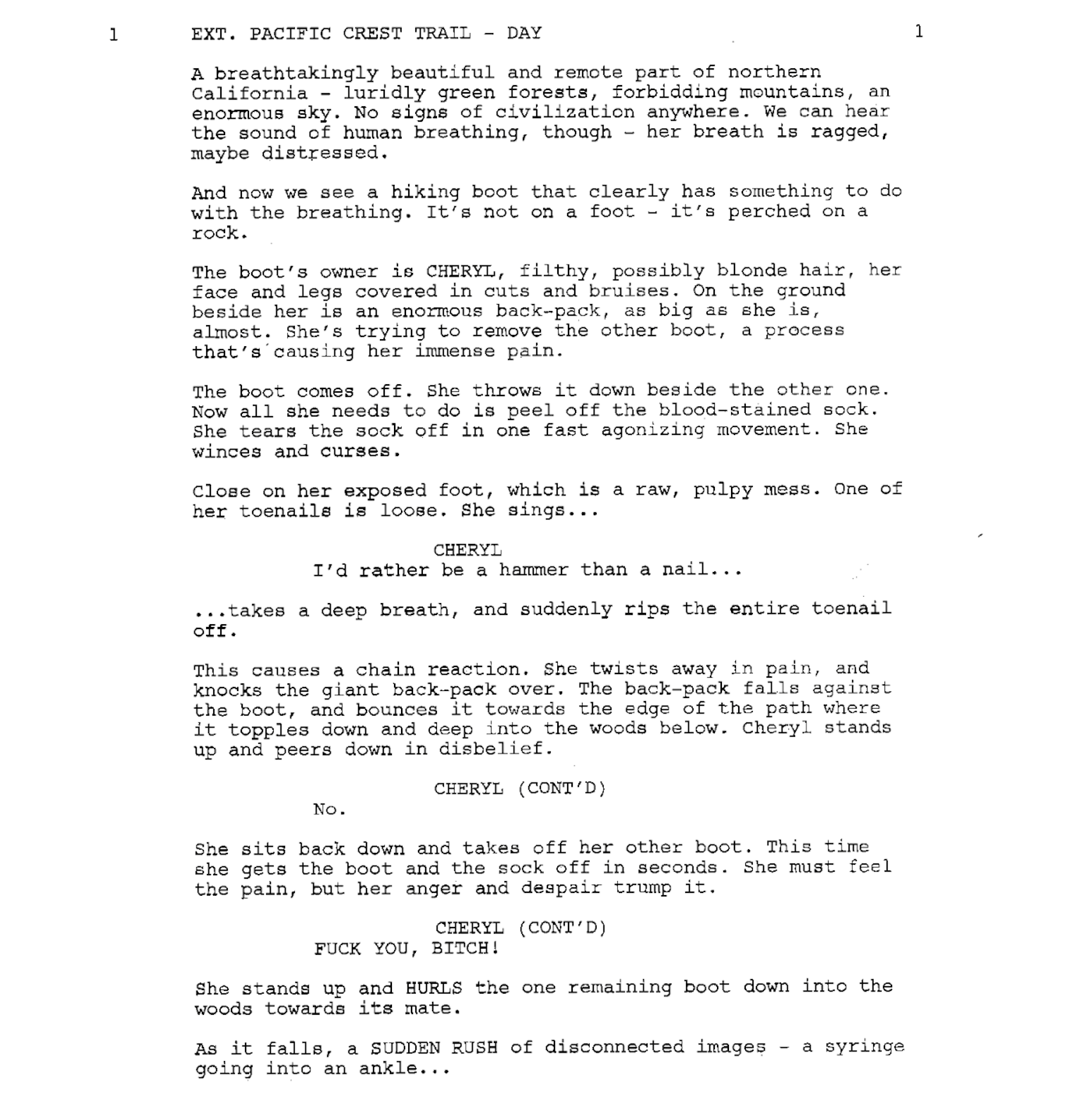
A few things to consider in the writing:
This script opens with immediate high stakes. A worn-out woman is at the top of a mountain with an injured foot. The description of her bloody toenail says this story is not for the weak of stomach. Also, blood feels urgent.
To make matters way worse, now she’s lost her shoe. Right away, the urgency is escalated and there’s a question— how on earth is she going to get safely down from this mountain?
When Cheryl angrily HURLS her other boot off the mountain, she becomes an intriguing character we want follow from the draw. Then, she curses and we love and want to follow her even more.
If you’re looking to improve the first page of your own screenplay, remember, a good first page:
Introduces a character we feel compelled to follow.
Establishes the tone, theme and symbols of the film.
Creates anticipation around what will happen next, so we turn to page two.
We hope the examples are helpful and that you can apply the techniques and lessons presented here when tackling your own work, no matter your preferred writing medium. Happy writing!
Libraries aren’t just for research and reading — they’re centers for community. Help us continue to preserve the work of film and TV writers and uplift the next generation by making a donation today.